
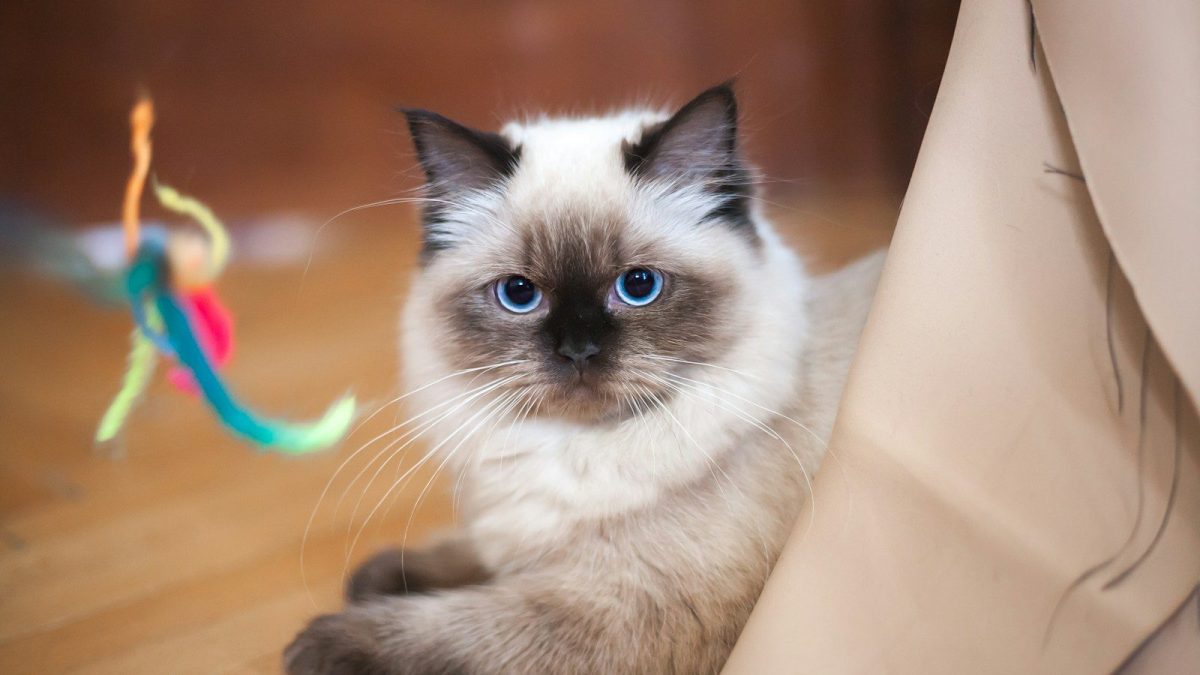
Overview
The Ragdoll is a large, semi-longhaired cat known for going limp and relaxed when you pick it up — that trait is where the name comes from. They’re one of the biggest domestic cat breeds, with males often reaching 15 to 20 pounds and taking up to four years to fully mature. Blue eyes, a soft coat, and colorpoint markings (darker face, ears, legs, and tail) are the hallmarks.
What sets a Ragdoll apart isn’t looks, though — it’s disposition. This is a cat bred for gentleness and attachment to people. Most Ragdolls want to be near their humans, will trot to the door to greet you, and often flop down beside you rather than hiding under the bed. Some fans call them ‘puppy-like,’ and that’s not far off.
They are not a low-involvement pet. A Ragdoll left alone for long stretches, day after day, tends to become lonely and can get clingy or withdrawn. If you want a cat who’s independent and content on its own terms, this probably isn’t your breed. If you want a soft, sociable shadow, the Ragdoll delivers in a way few cats do.
Breed Origin & History
The Ragdoll traces back to 1960s Riverside, California, and a breeder named Ann Baker. She began with a longhaired white domestic cat named Josephine and selectively bred her offspring for a calm temperament, large size, and the relaxed ‘go-limp’ handling response. Baker trademarked the Ragdoll name and set up her own registry, which created decades of friction and splintering within the breed community.
Despite that rocky start, breeders who wanted mainstream recognition worked to establish the Ragdoll through the major cat registries. The Cat Fanciers’ Association (CFA) granted the breed full recognition in 2000, and The International Cat Association (TICA) recognizes it as well. Some of the more colorful origin stories Baker promoted — including claims about the cats being immune to pain — are not supported by any evidence and should be treated as myth, not history.
Today the Ragdoll is one of the most popular breeds in the United States. It comes in recognized colors like seal, blue, chocolate, lilac, red, and cream, and in patterns including colorpoint, mitted, and bicolor. Kittens are born white and develop their color and markings over the first weeks and months. Full coat and size can take up to three or four years to arrive, so the cat you adopt at twelve weeks will keep changing for a while.
Temperament & Personality
Ragdolls are famous for being docile, affectionate, and easygoing. Most greet family members, follow people around the house, and settle in laps or beside you on the couch. They tend to have quiet, soft voices and are not typically loud or demanding vocalizers, though many will chirp to get your attention.
Here’s the honest trade-off: the same softness that makes them wonderful companions also makes them poorly suited to certain households. Ragdolls are trusting and often lack the street-smart wariness of more independent breeds. That’s part of why the breed community and most vets strongly recommend keeping them indoors — a friendly, slow-moving cat with no fear of strangers or cars is vulnerable outside.
They also bond hard. A Ragdoll who’s home alone eight or ten hours a day, every day, with no other company can become lonely. This isn’t a cat that shrugs off your absence. Many do better with a second pet for company.
Temperament-wise, they’re generally gentle with children and tolerant of handling, which is why they show up so often as family cats. But ‘gentle’ doesn’t mean ‘indestructible’ — a Ragdoll that goes limp in a child’s arms still needs supervision and respectful handling. Individual cats vary. Some are true velcro cats; others are affectionate but a bit more reserved. Meet the actual cat before assuming.
Is This Breed Right for You?
A Ragdoll is a strong fit if you’re home a lot — remote workers, retirees, families with someone usually around, or households with another compatible pet. They suit people who genuinely want a cat that’s involved in daily life: sitting with you, following you between rooms, sleeping on the bed. If your idea of a good cat is one that seeks you out rather than ignores you, this breed is built for it.
They also work well for committed indoor-cat households. If you have a secure home, a catio, or you’re willing to leash-train, the Ragdoll’s indoor-friendly nature is a plus. Their calm energy makes them manageable in apartments and homes without a lot of space to roam.
Who should skip this breed? Anyone who’s gone most of the day, every day, and doesn’t plan to get a second pet — a lonely Ragdoll is a sad Ragdoll. People who want a low-maintenance, hands-off, semi-feral ‘barn cat’ personality will be mismatched. If you want a cat you can let outdoors to fend for itself, this breed is genuinely the wrong choice; their trust and low fear response makes outdoor life dangerous.
Also think twice if allergies are a concern. Ragdolls are not hypoallergenic and they shed and produce dander like any other cat. And budget realistically: a large cat with a semi-long coat means more food, larger litter setups, and regular grooming time. None of that is dramatic, but it’s real. The best owner here is someone who wants companionship, keeps the cat indoors, and can be present or provide company.
Care & Exercise Needs
Ragdolls are moderate-energy cats. They like to play but aren’t the frantic climbers some breeds are. Aim for two or three short play sessions a day — 10 to 15 minutes each — with wand toys, chase toys, or puzzle feeders to keep them engaged. Because they can be prone to weight gain, especially indoors, structured play and portion control matter more than for a leaner, busier breed.
Grooming is the biggest ongoing task. The coat is semi-long and silky, and while it mats less than a dense double coat, it still needs brushing two or three times a week to prevent tangles behind the ears, under the legs, and along the belly. Expect more shedding in spring and fall. Regular brushing also cuts down on hairballs. Keep nails trimmed and check ears and teeth on the schedule your vet recommends.
Mentally, Ragdolls are social learners. Many take well to leash and harness training, come when called, and even learn simple tricks with positive reinforcement — food rewards and patience, never punishment. Keep sessions short and upbeat.
The single most important care decision is keeping them indoors or in a securely enclosed outdoor space. Provide vertical space (cat trees, shelves), scratching surfaces, and a clean, large litter box — big cats appreciate big boxes. If you’re away for long hours, seriously consider a companion pet. A bored, lonely Ragdoll is the most common avoidable problem with this breed.
Health Considerations
Ragdolls are generally healthy but the breed is known to have a higher incidence of a few specific conditions. The most significant is hypertrophic cardiomyopathy (HCM), a heart-muscle disease seen in many cat breeds; a specific genetic mutation associated with HCM has been identified in Ragdolls, and responsible breeders screen for it. The breed is also known to have an elevated risk of polycystic kidney disease (PKD) and, like many large cats, can be predisposed to urinary tract issues and obesity-related problems.
Because they’re big and slow to mature, joint health and weight management matter throughout life. Excess weight compounds nearly every other health risk, so keeping a Ragdoll lean is one of the most useful things an owner can do.
Ask about genetic testing when you’re getting a kitten — screening for HCM and PKD is standard among conscientious breeders, and parent clubs encourage it. Adult Ragdolls benefit from regular wellness checks so any heart or kidney changes can be caught early.
Typical lifespan runs roughly 12 to 17 years, and many indoor Ragdolls live well into their teens with good care. None of this is meant as a diagnosis or a treatment plan — every cat is an individual, and health tendencies are not guarantees. For any concern about your specific cat, or before making decisions about testing, diet, or care, consult your veterinarian.
Recommended Gear Categories
A few gear categories genuinely matter for this breed. Because Ragdolls are large, look for a litter box that’s oversized — many owners use extra-large or storage-tote-style boxes so a big cat can turn around comfortably. A sturdy, tall cat tree rated for larger cats gives them vertical space without wobbling.
For the coat, invest in a good slicker or grooming comb suited to semi-long hair, plus a de-shedding tool for seasonal coat blows. A soft-bristle finishing brush helps with the silky topcoat.
Many Ragdolls take to leash walking, so a properly fitted cat harness — the vest or H-style types that distribute pressure — is worth considering if you want safe outdoor time. For play and weight management, puzzle feeders and wand toys earn their keep. Choose feeding bowls or slow feeders that suit a larger cat’s frame. Your editor can add specific product picks; these are the categories that matter for a big, plush, people-oriented indoor cat.
Similar Breeds to Consider
If you love the Ragdoll’s size and plush coat but want a cat with a little more independence and personality edge, look at the Birman. Birmans are also colorpoint, blue-eyed, and affectionate, but many are a touch more active and self-directed than the ultra-mellow Ragdoll.
For someone drawn to the big, gentle, family-cat profile but wanting a very sturdy, cold-hardy cat, the Maine Coon is worth comparing. Maine Coons are similarly large and sociable, often described as dog-like, but they tend to be more playful and less prone to the total-flop relaxation the Ragdoll is known for. Their coat is denser and needs comparable grooming.
If your heart is set on a deeply affectionate lap cat but you’d prefer a smaller cat or less coat maintenance, consider the Siamese or the closely related Balinese. Both are intensely people-oriented and vocal — much chattier than a Ragdoll — which is a plus if you want conversation and a minus if you want quiet. The Balinese offers a longer coat with a talkative personality, while the Siamese gives you the same devotion in a sleek, low-grooming package.