
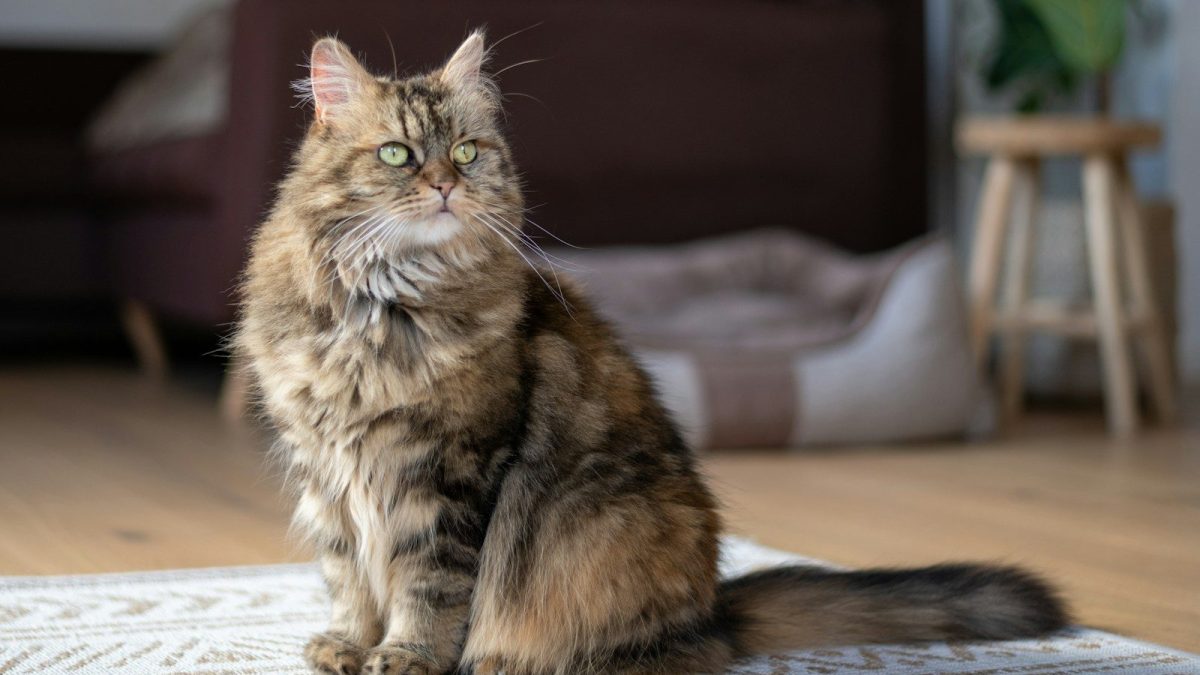
Overview
The Maine Coon is one of the largest domestic cat breeds, and the size is the first thing everyone mentions. Males routinely hit 13 to 18 pounds, and some go higher. But the size isn’t really the point. What makes people fall for this breed is the personality: friendly, chatty, and unusually people-oriented for a cat.
They’re often called the ‘gentle giant,’ and it fits. Most Maine Coons are relaxed, tolerant, and slow to anger. They tend to follow their people from room to room, supervise chores, and settle nearby rather than off in a distant corner. They’re not lap cats in the clingy sense — many prefer to be near you rather than on you — but they want to be involved.
Physically, they’re built for cold. The coat is long, shaggy, and water-resistant, heavier around the neck and britches. They have big tufted paws, lynx-tipped ears, and a long bushy tail they wrap around themselves. The look is impressive, and it’s also a lot of coat to maintain. This is a breed you commit to grooming, not one you set and forget.
Breed Origin & History
The Maine Coon is one of America’s oldest natural breeds, native to the state of Maine, where it’s the official state cat. The exact origin is more folklore than fact. The charming stories — that they descend from raccoons (biologically impossible) or from Marie Antoinette’s cats shipped to America — are fun but not true. The likelier explanation is that longhaired cats brought by sailors bred with local shorthaired working cats, and natural selection in a harsh New England climate did the rest. The heavy coat, big body, and tufted feet are cold-weather adaptations.
They were prized as barn and ship cats for their hunting ability and hardiness. Maine Coons appeared in early American cat shows in the late 1800s, and one won Best Cat at the 1895 Madison Square Garden show. When flashier imported breeds like Persians gained popularity in the early 1900s, the Maine Coon faded, and some believed it was heading toward extinction.
Dedicated breeders revived it mid-century. The Cat Fanciers’ Association (CFA) accepted the breed for championship status in 1976. Today the Maine Coon is consistently among the most popular pedigreed cats registered with CFA. It’s recognized by TICA, CFA, and the FCI, though registries differ slightly on ideal size and coat standards.
Temperament & Personality
Maine Coons are famous for being ‘dog-like,’ and there’s truth to it. Many enjoy fetch, come when called, walk on a harness, and greet the door. They’re social and want company, which is exactly why they’re so beloved — and also the trade-off.
This is not a breed that thrives left alone all day, every day. They’re not as intensely needy as some Oriental breeds, but a Maine Coon who’s isolated for long stretches often becomes bored and mischievous, or simply less content. If your household is empty ten hours a day, plan for a second pet or serious enrichment.
They’re talkers, but not in the loud, demanding way of a Siamese. The signature sound is a chirp or trill — a soft, funny warble they use to comment on things. Some owners find it endlessly charming. If you want a silent cat, this isn’t it.
Most Maine Coons are patient and even-tempered, which makes them good with children and other animals when introductions are done properly. They mature slowly — physically and mentally — often not reaching full size until three or four years old. Expect kitten-like playfulness to linger well into adulthood. They’re intelligent and curious, which means they get into things: cabinets, running water, anything that moves. Boredom in a smart cat becomes your problem.
Is This Breed Right for You?
A Maine Coon suits someone who wants a cat that’s genuinely part of daily life — a companion that hangs around, responds to you, and enjoys interaction. Families with children do well with this breed because most Maine Coons tolerate handling and noise better than more sensitive cats. Homes with existing pets often work, since Maine Coons tend to be socially confident rather than territorial. First-time cat owners can absolutely handle one, as long as they understand the grooming and cost commitment going in.
They’re a strong fit for households where someone is home a fair amount, or where there’s a second animal for company. They also suit people who like the idea of training a cat — harness walks, fetch, clicker tricks — because Maine Coons are trainable and enjoy the engagement.
Who should think twice: anyone who wants a low-maintenance cat. The coat needs real, consistent grooming, and the sheer body size means bigger litter boxes, sturdier furniture, more food, and higher costs across the board. If you want a cat who’s mostly invisible and self-sufficient, a more independent breed will make you happier. People who are away from home for very long days should reconsider or commit to companionship for the cat.
Also think twice if budget is tight. Beyond food and litter, this breed has known genetic health risks that can mean expensive vet care, and responsible ownership means being financially ready for that. This is a big, long-lived, high-involvement animal — rewarding if that’s what you want, a lot of cat if it isn’t.
Care & Exercise Needs
Grooming is the biggest ongoing job. The long, dense coat needs brushing at least two to three times a week, and often daily during seasonal shedding. Skip it, and you’ll get mats, especially behind the ears, under the legs, on the britches, and along the belly. A metal comb and a slicker brush are the working tools. Get them used to grooming as kittens — a mat-covered adult cat who hates brushing is a genuine headache.
They shed a lot, and it’s noticeable. Expect fur on furniture and clothing year-round, heavier in spring and fall. Regular brushing reduces it and cuts down on hairballs.
For enrichment, aim for at least two 10 to 15 minute active play sessions daily — wand toys, fetch, puzzle feeders. Maine Coons are intelligent and get bored, so rotate toys and add climbing space. Because they’re large, invest in oversized, sturdy cat trees and a jumbo litter box; a standard box is often too small for an adult male.
Many enjoy water — dripping faucets, splashing bowls — and a pet water fountain can encourage drinking. Trim nails every couple of weeks and check ears during grooming.
Training is easier than with most cats. They respond to positive reinforcement, so clicker training, recall, and harness walks are all realistic goals if you start young and keep sessions short and rewarding. Keep feeding controlled and measured — large cats can carry excess weight easily, and obesity worsens joint and heart risks.
Health Considerations
Maine Coons are generally hardy, but the breed is known to have a higher incidence of a few specific conditions, and prospective owners should understand them. Hypertrophic cardiomyopathy (HCM), a heart muscle disease, occurs in the breed, and a specific genetic mutation associated with HCM has been identified in Maine Coons. Hip dysplasia — more often discussed in dogs — is also documented in this breed, likely related to its large size. Spinal muscular atrophy (SMA), an inherited condition affecting the muscles, has a known genetic test available. Polycystic kidney disease is another concern seen in some lines.
Reputable breeders screen breeding cats for HCM (via cardiac ultrasound) and use available DNA tests for SMA and the HCM mutation, and can show hip evaluations. Ask for documentation.
Because of their size and slow maturation, keeping a Maine Coon at a healthy weight matters more than average — excess weight strains joints and the heart. Annual vet exams, and more frequent checks as they age, help catch issues early. This breed typically lives 10 to 15 years, and many stay playful late into life.
None of this should scare you off; it should inform you. A Maine Coon is a long-term financial and medical commitment. For any specific concern about your individual cat’s health, screening options, or symptoms, consult your veterinarian.
Recommended Gear Categories
Buy for the size. A jumbo, high-sided litter box matters — many standard boxes are too small for an adult, which leads to litter box problems that get blamed on the cat. Look for oversized cat trees and shelves rated for heavier animals; flimsy furniture won’t survive a 16-pound cat launching onto it.
Grooming tools are non-negotiable: a stainless steel comb for working through the undercoat and a slicker brush for the topcoat. A de-shedding tool helps during seasonal blowouts. For the water-loving tendency, a pet water fountain often encourages better hydration.
If you plan to leash-train, choose an escape-proof cat harness with a snug figure-eight or vest design, not a simple collar. Puzzle feeders and interactive toys are worth having on hand for a smart, easily bored cat. And because they carry weight easily, a measuring scoop or scale for portioning food is genuinely useful. Your editor will link specific products where relevant.
Similar Breeds to Consider
If you love the size and gentle nature of the Maine Coon but want something even calmer, look at the Ragdoll. Ragdolls are large, floppy, and famously placid — many go limp when picked up. They’re more likely to be true lap cats and slightly less mischievous, though they need similar grooming and companionship.
The Norwegian Forest Cat is the closest natural comparison. It’s another big, cold-adapted longhair with a thick water-resistant coat and an independent-but-friendly personality. It tends to be a bit more reserved and self-sufficient than a Maine Coon, which suits owners who want the impressive looks without quite as much in-your-business sociability. The Siberian is a third heavy-coated option, playful and affectionate, and often cited anecdotally as producing fewer allergic reactions — though no cat is truly hypoallergenic.
If the grooming commitment is the dealbreaker but you want the big, friendly, dog-like temperament, consider a shorthaired sociable breed like the Abyssinian or a British Shorthair. You lose the dramatic coat and get far easier maintenance, while keeping an engaged, people-oriented companion — the British Shorthair being the calmer of the two.
Attributes
Array