

Panic, not protest
The first thing to get right is what separation anxiety actually is. It is not a dog objecting to your absence or getting revenge for being left. It is panic — a genuine distress response that the dog has no more control over than a person having a panic attack does.
That distinction matters because it determines what works. You cannot correct panic out of a dog. Punishing a dog for what it did while distressed adds fear to an already fearful situation and reliably makes the problem worse. Owners who come home to destruction and tell the dog off are, from the dog’s point of view, confirming that being left alone leads to something bad.
It also matters because true separation anxiety is often confused with boredom, and the two need different responses. A bored dog chews the furniture and then sleeps. An anxious dog typically starts within minutes of you leaving, often before you have reached the car, and does not settle at all.
The practical way to tell them apart is to record it. A phone or a cheap camera pointed at the room tells you more in one afternoon than weeks of guessing. Look at when the behavior starts, whether the dog settles at any point, and whether it is oriented toward your exit — the door, the window, your belongings — or just destructive in general.
Breeds where the risk is structural

Some breeds are genuinely more prone to this, and it is usually a direct consequence of what they were bred for.
The Vizsla is the clearest example. Bred to work in constant close communication with a handler, it is known as a velcro dog for good reason, and separation anxiety is more common and more severe in the breed than in most. Weimaraners carry a similar reputation for similar reasons.
Companion breeds developed for centuries of constant human company — the Havanese, the Shih Tzu, and toy breeds generally — are also over-represented, because being alone was never part of the job description.
So are the intensely handler-focused gundogs. English Springer Spaniel owners are told plainly by the breed’s parent club that these dogs are unhappy when shut out, tied out or isolated.
None of this means those breeds cannot be left alone. It means the tolerance has to be deliberately built rather than assumed, and that a household out for ten hours a day should think seriously before choosing one. The honest version is: pick the breed to match your schedule, or arrange your schedule to match the breed. Hoping it works out is how dogs end up in rescue.
What actually helps
The core of the work is gradual, planned absence. Start far below the threshold where the dog gets worried — sometimes that is thirty seconds, sometimes it is you standing on the other side of a door for five. Return before the dog becomes distressed, not after. Build the duration slowly and irregularly, so it does not become predictable. Progress is measured in the dog staying relaxed, not in minutes survived.
This is unglamorous and slow, and it is the part that works. Everything else supports it.
Make departures boring. Elaborate goodbyes and enthusiastic reunions both raise the emotional stakes around the door. Leave and return calmly.
Defuse the departure cues. Dogs learn that keys, shoes and coats predict absence. Pick up your keys and sit down. Put your coat on and make coffee. Do it often enough that the cues stop meaning anything.
Give the dog something to do at the moment you leave — a stuffed and frozen food toy, a long-lasting chew, a puzzle feeder. This builds a positive association with the departure and occupies the window when anxiety peaks.
And exercise before you leave. A dog that has genuinely worked in the morning is far more likely to settle, which is why so many separation problems in high-energy breeds are really exercise problems wearing a disguise.
What makes it worse
Punishment after the fact. The dog cannot connect a telling-off with something it did two hours ago in a state of panic. All it learns is that your return is unpredictable and unpleasant.
Flooding — leaving the dog alone for long periods to “get used to it.” This is the opposite of graduated exposure, and it typically deepens the panic rather than habituating the dog to it.
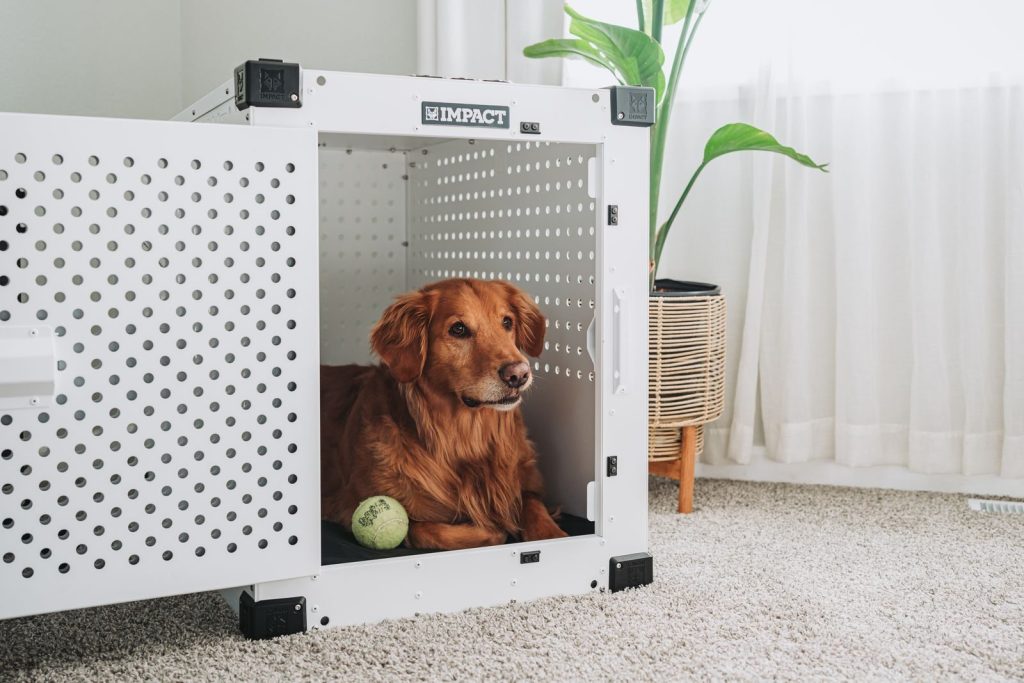
Crating a dog that panics in a crate. Crates help many dogs and are genuinely useful when introduced positively, but a dog that is already distressed and then confined can injure itself trying to escape. If crating raises the distress, it is not the tool for that dog.
Getting a second dog as a fix. Sometimes it helps. Often it does not, because the attachment is to you specifically, and you can end up with two anxious dogs instead of one. It is an expensive experiment to run on a guess.
And waiting. Separation anxiety rarely resolves on its own and often escalates. If your dog is showing genuine distress — destruction focused on exits, non-stop vocalizing, drooling, refusing food when alone, or self-injury — that warrants professional help rather than more internet reading. A qualified behaviorist or a veterinarian can assess the individual dog, rule out other causes and build a plan. That is a normal, sensible step, not an admission of failure.