
Overview
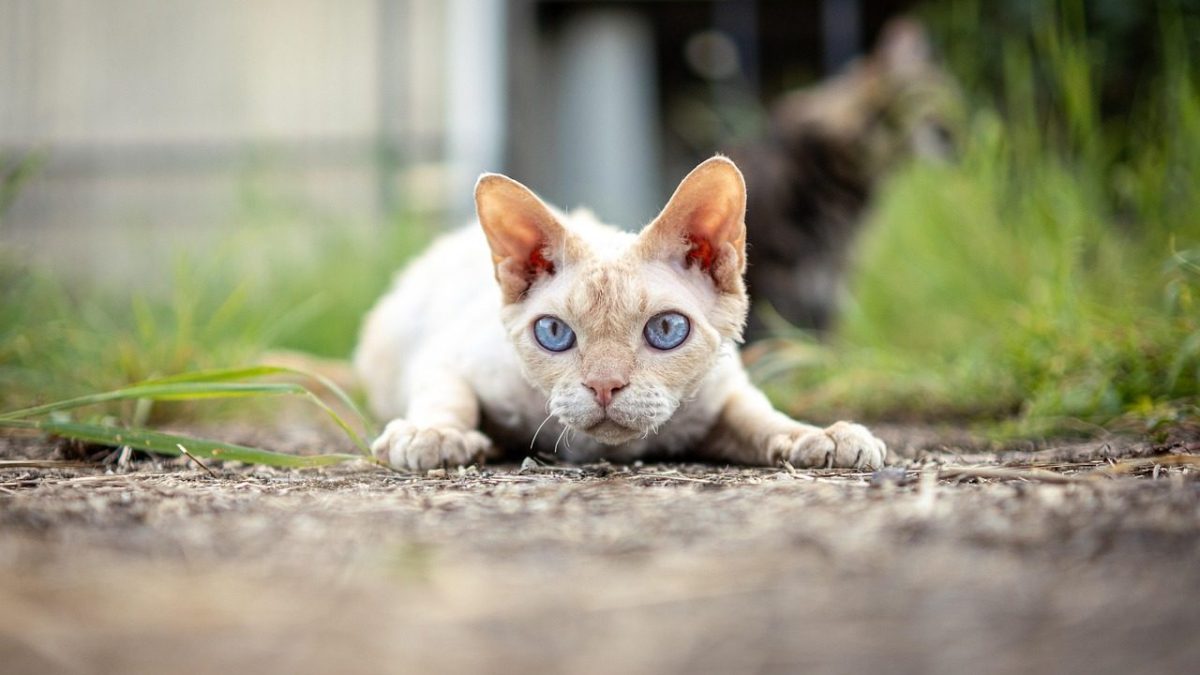
The Devon Rex is immediately recognizable: a small cat with a short, soft, wavy coat, oversized ears set low on a wide head, large eyes and prominent cheekbones. The look is often described as elfin or, less kindly, alien. Adults are small — typically 6 to 9 pounds — with a surprisingly muscular body under the sparse coat.
The coat comes from a spontaneous mutation and is genuinely different from the Cornish Rex’s. The two mutations are distinct and not interchangeable, which is why crossing the two breeds produces straight-coated kittens rather than curly ones. The Devon’s coat is looser and more tousled than the Cornish’s tight marcel wave, and it is often sparse, particularly on the chest and belly.
Temperamentally this is one of the most people-dependent cats in existence. Devons ride on shoulders, sit on keyboards, get into whatever you are doing, and seek warmth relentlessly — under duvets, on laps, against radiators, on top of a sleeping dog. They retain kittenish playfulness into old age.
Here is the honest headline. If you want a cat that functions like a small, warm, permanently attached companion and you are home a great deal, the Devon Rex is a joy. If you want a self-sufficient animal, or you are out for long days with a single cat at home, this is close to the worst breed you could choose.
Breed Origin & History
The breed began with a single cat. In 1960 a curly-coated kitten named Kirlee was born in Devon, England, to a stray female living near a disused tin mine. The kitten’s unusual coat attracted attention, and because a curly-coated breed — the Cornish Rex — had already appeared in neighboring Cornwall a decade earlier, the natural assumption was that the two shared a mutation.
They do not. When Kirlee was bred to Cornish Rex cats, the offspring all had straight coats, demonstrating that the two curly coats arise from different recessive genes. That test breeding is the reason the Devon Rex exists as a separate breed rather than a variant, and it is a rare case where a clean genetic experiment settled a breed question immediately.
Every Devon Rex alive descends from Kirlee, which is an extremely narrow foundation even by pedigree cat standards. Breeders have used outcrossing to broaden the gene pool over the decades, but the bottleneck is directly relevant to the inherited conditions documented in the breed.
The Cat Fanciers’ Association recognizes the breed and maintains its standard, which describes the distinctive head shape, the low-set large ears and the soft wavy coat.
Temperament & Personality
Devon Rex cats are intensely social, playful, curious and physically affectionate. They want contact and they pursue it — perching on shoulders, burrowing under blankets, inserting themselves between you and whatever you are reading. Many owners describe them as behaving more like small dogs or mischievous primates than like typical cats.
They are intelligent and trainable by cat standards. Fetch is common, harness walking is realistic, and many learn tricks and respond to their names. Puzzle feeders and clicker training suit them well.
They stay playful far longer than most breeds — a ten-year-old Devon often still behaves like an adolescent.
Heat-seeking is a defining behavior rather than a quirk. With a sparse coat and relatively little insulation, Devons genuinely feel the cold and will find the warmest available spot, which is frequently under the covers, on a laptop, or pressed against a person. They also feel cold rooms more than a normal-coated cat.
The trade-off is complete social dependence. Devons do not do well alone. Long days by themselves produce distress, destructive behavior and over-attachment problems, and experienced owners very commonly keep them in pairs. For a household that is out at work, a second cat is close to a requirement rather than an option.
They are typically excellent with children, dogs and other cats, greeting visitors with interest rather than suspicion.
Is This Breed Right for You?
The Devon Rex suits people who want an intensely involved companion and can provide company. Specifically: people who work from home or are otherwise around much of the day. Households prepared to keep two cats. Families with children, since the breed is playful, tolerant and sociable. Multi-pet homes, including those with dogs. Apartment dwellers, given the small size and indoor suitability. Owners who enjoy interaction, training and play rather than regarding them as chores. Anyone who wants a cat that will genuinely sit on them.
It also suits people who want a small cat with minimal shedding, though the coat needs a different kind of attention rather than none.
Here is who should think twice. Anyone out of the house for long working days with a single cat — this is the breed’s most serious limitation and the consequences for the cat are real. People wanting an independent or dignified cat. Households that need their laptops, dinner plates and shoulders left alone. Anyone in a cold home unwilling to provide warm places, since a sparse-coated cat genuinely suffers in the cold. Anyone unwilling to ask a breeder about hereditary myopathy and coagulopathy, both of which are DNA testable in this breed.
And anyone buying on the hypoallergenic claim should be careful. The Devon Rex sheds little, which is not the same as producing less of the protein that causes reactions. Spend real time with the breed before committing.
If you want a warm, funny, permanently attached companion and you are home for it, few breeds deliver more personality per pound.
Care & Exercise Needs
Coat and skin care is different from other breeds rather than heavier. The wavy coat needs almost no brushing — and aggressive brushing can damage the delicate hairs. A gentle stroke with a soft cloth or your hands is usually enough.
What the coat does not do is absorb skin oils the way a normal coat does, so oil can build up on the skin and particularly in the large ears. Many Devons need periodic gentle ear cleaning and some need an occasional bath with a mild cat-safe shampoo if the skin becomes greasy. Frequency varies a lot between individuals — some need nothing, some need regular attention.
Warmth is a genuine care requirement. Provide heated or well-insulated beds, keep the house comfortable, and expect the cat to seek out your bed and your lap. Conversely, the sparse coat offers little sun protection, and light-colored Devons can sunburn through a window.
Companionship is likewise a care requirement rather than a preference. Plan for a second pet or substantial human presence.
Exercise and enrichment matter for a cat that stays kittenish: daily interactive play, climbing structures, puzzle feeders and rotating toys. Devons are agile climbers despite their size.
Otherwise routine care applies — nail trimming, dental attention and regular veterinary checkups, with particular attention to any change in gait or muscle strength given the conditions below.
Health Considerations
Descending entirely from one cat, the Devon Rex carries several well-documented inherited conditions, and this is a breed where DNA testing questions are essential rather than optional.
Devon Rex myopathy — also called hereditary myopathy or spasticity — is the condition most specific to the breed. It is an inherited muscular disorder causing generalized weakness, a characteristic head-bobbing or ventroflexed neck posture, and difficulty swallowing that can lead to choking. Signs typically appear in young cats. A DNA test is available and responsible breeders test their breeding stock.
An inherited coagulopathy — a vitamin K-dependent clotting factor deficiency — is also documented in the breed and causes abnormal bleeding. It too is DNA testable, and knowing a cat’s status matters before any surgery.
Hypertrophic cardiomyopathy occurs, as in many pedigree breeds, and breeders should be screening breeding cats by echocardiogram.
Patellar luxation is reported at elevated rates and can range from an intermittent skip in the gait to a condition needing surgical correction.
Skin conditions are common and relate to the coat. Malassezia dermatitis, a yeast overgrowth producing greasy, itchy, sometimes smelly skin and ear inflammation, appears more often in this breed than in most. Urticaria pigmentosa, a crusting skin condition, is also reported.
A healthy Devon Rex commonly lives 9 to 15 years. Ask breeders specifically for myopathy and coagulopathy DNA results on both parents. For any concern about your cat’s strength, gait, bleeding, skin or breathing, consult your veterinarian rather than relying on general breed information.
Recommended Gear Categories
Warmth gear is the category that matters most and it is genuinely functional. Heated cat beds, thick soft bedding, covered or hooded beds and cat caves all get constant use from a sparse-coated heat-seeking cat. A spot near a radiator or a sunny window will be claimed permanently.
Skin and ear care supplies come next: cat-safe ear cleaner, soft cotton pads and a mild cat shampoo for the occasional bath when the skin becomes greasy. Not every Devon needs bathing, but most need ear attention.
Grooming tools should be minimal and gentle — a soft cloth or a very soft brush. Slickers and combs designed for dense coats can damage the fine wavy hair.
Enrichment should be generous, because this is a lifelong-kitten breed that is also clever. Wand toys, fetch toys, puzzle feeders, treat-dispensing balls and a rotating toy collection all earn their place. Devons are agile climbers, so cat trees and shelving suit them despite their size.
A harness and lead are realistic here — many Devons take to harness walking readily and it is a genuine outlet for their curiosity.
For households out during the day, a camera and an automatic timed feeder help, though neither substitutes for a companion animal. Your editor will add specific product recommendations with current pricing and details.
Similar Breeds to Consider
The Cornish Rex is the obvious comparison — the other curly-coated breed, from a different mutation. The Cornish coat is a tighter, more uniform marcel wave and the body is more slender and whippet-like; the Devon’s coat is looser and its head shape more extreme. Temperaments are similar, both being highly social and playful, with the Cornish often described as even more athletic. Either suits the same kind of household.
The Sphynx is worth considering for someone drawn to the Devon’s personality and unusual appearance who wants to go further. Sphynx are similarly people-dependent and warmth-seeking, with more intensive skin care needs and no coat at all.
The Burmese is the alternative for someone who wants comparable devotion and playfulness in a conventionally coated cat. It is similarly poor at being alone and similarly lap-oriented, with a short satiny coat that needs nothing.
The Oriental Shorthair offers a similar level of social engagement and intelligence in a sleek, normal-coated body, at the cost of considerably more noise.
If the social dependence is the obstacle rather than the coat, there is no version of this breed that is happy alone. A British Shorthair or Russian Blue would be the honest alternative, accepting a completely different personality. In short: choose the Devon Rex for maximum personality in a small warm package, the Cornish Rex for a similar cat with a different curl, the Sphynx to go further, and the Burmese for the same devotion with an ordinary coat.