
Overview
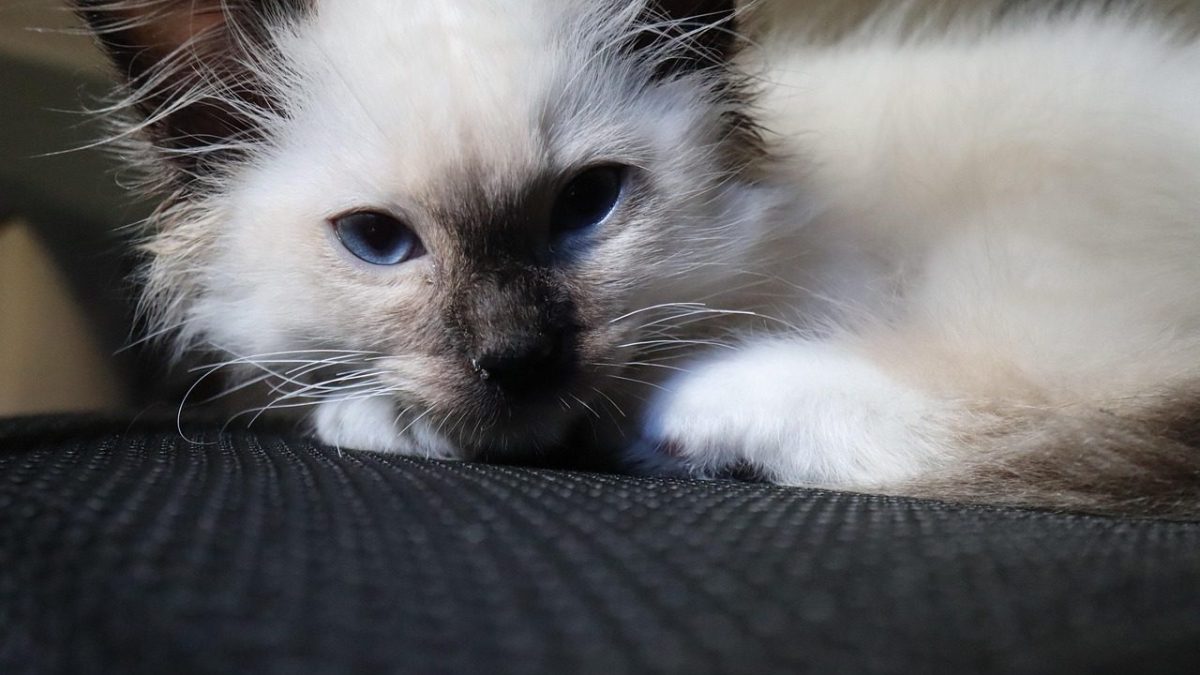
The Birman is a medium-to-large semi-longhaired cat with a colorpoint coat — darker points on the face, ears, legs and tail against a paler body — deep blue eyes, and one feature that belongs to no other breed: pure white gloves on all four feet. On the front paws the white stops in an even line across the knuckles; on the back it extends up the rear of the leg in what breeders call laces. Symmetry in those markings is central to the breed standard and genuinely difficult to produce.
Most adults run 8 to 12 pounds, with males often larger, on a solid, substantial frame.
The coat is the practical surprise. It is semi-long and silky, but unlike the Persian it carries very little undercoat, and that single fact means it resists matting far better than its length suggests. Grooming is real but modest — nothing like the daily obligation a Persian imposes.
Temperamentally the Birman sits in a useful middle ground. It is affectionate, people-oriented and happy to be involved, but it is not demanding in the way a Burmese or Siamese is, and it is not reserved in the way a Russian Blue is. The voice is soft and used sparingly.
Here is the honest headline. For a family that wants a beautiful, gentle, quiet cat without either a high-maintenance coat or a high-maintenance personality, the Birman is one of the most balanced choices available.
Breed Origin & History
The Birman’s origin story is a good one and almost certainly a legend. The traditional account describes temple cats in Burma, companions to priests, transformed in appearance by a goddess as a reward for loyalty — the golden body, the sapphire eyes, and the white paws left where the cat rested against its dying keeper. It is a lovely story and there is no documentary evidence for it.
What is documented is that the breed was established in France in the early twentieth century, where breeding records begin. Whether the foundation cats came from Burma or were developed from colorpoint and white-footed stock in Europe is genuinely unresolved.
The breed was nearly destroyed during the Second World War, with the European population reduced to a very small number of surviving cats. Reconstruction involved outcrossing to other breeds — Persian and Siamese among them — before the type was re-established and the studbook closed again. As with several breeds rebuilt from a narrow base, that history is relevant to the inherited conditions discussed below.
The Cat Fanciers’ Association recognizes the breed and maintains its standard, which places considerable weight on the gloves and laces. Those markings are polygenic and hard to get right, which is part of why well-marked Birmans command what they do and why breeders talk about them constantly.
Temperament & Personality
Birmans are gentle, calm and sociable without being insistent. They like being with their people, will follow you between rooms and settle nearby, and many are genuinely lap-inclined — but they ask rather than demand, and they cope with being ignored better than the more intense Asian breeds.
The voice is soft and infrequent. Despite the Siamese influence in the breed’s reconstruction, Birmans are not talkative cats, which makes them well suited to apartments and shared walls.
They are moderately playful, holding onto a kittenish streak into adulthood without the relentless athleticism of an Abyssinian. Most are ground-oriented rather than dedicated climbers, which means fewer incidents involving high shelves than you get with a Norwegian Forest Cat.
With children, dogs and other cats they are typically excellent. The temperament is patient and slow to take offense, and Birmans generally greet visitors with curiosity rather than hiding. For a busy household that wants a calm cat, this combination is hard to beat.
The main trade-off is that Birmans are companionable enough to be unhappy in an empty house for long stretches. They are not as dependent as a Burmese, but they are not self-sufficient loners either, and a second pet often suits them well.
Individual variation exists, but the breed is notably consistent — most Birmans you meet are gentle, quiet and easy.
Is This Breed Right for You?
The Birman suits households that want a beautiful, calm, sociable cat without a demanding personality or a demanding coat. Specifically: families with children, since the temperament is patient and the cat is sturdy. Multi-pet homes, including those with dogs. Apartment dwellers, given the quiet voice and moderate activity. First-time cat owners, because the breed is forgiving and grooming is manageable. People who want a semi-longhaired cat but are unwilling to take on Persian-level maintenance. Anyone who wants a cat that greets visitors rather than hiding from them.
Here is who should think twice. Anyone who wants a genuinely low-grooming cat — twice-weekly brushing is still a commitment, and the ruff and trousers need attention. Households empty for very long days with a single cat, since Birmans are companionable. People wanting a highly active or acrobatic cat, or one that can be trained to fetch and walk on a harness; this is a calmer animal than that. Anyone hoping for a hypoallergenic cat, which the Birman is not.
And anyone buying purely on the markings should understand what they are paying for: symmetrical gloves and laces are hard to breed and are the main driver of price in this breed, not health or temperament. A slightly imperfect glove has no bearing on what the cat is like to live with.
If you want the look of a longhaired cat with the temperament of an easygoing one, the Birman is among the best-balanced pedigree cats available.
Care & Exercise Needs
Grooming is moderate and the light undercoat is what makes it manageable. Brush thoroughly twice a week with a metal comb, paying attention to the ruff around the neck, the trousers at the back legs and the area behind the ears, where mats form first. During seasonal shedding, increase frequency. A Birman that is combed regularly rarely needs the intervention a Persian does.
The colorpoint pattern is temperature-sensitive, which is a genuine curiosity rather than a care issue: the points darken in cooler conditions and lighten in warmth, and a shaved patch after surgery may grow back darker before fading again.
Diet deserves normal attention. Birmans are solidly built and moderately active, and indoor adults can gain weight. Measure portions rather than free-feeding and weigh periodically.
Because the breed is ground-oriented rather than a dedicated climber, vertical space matters less than for a Norwegian Forest Cat or Abyssinian, though perches and window seats are still welcome. A sturdy scratching post and regular nail trimming are standard.
Company matters. Plan for interaction, and consider a second pet if the house is empty for long days. Otherwise routine care applies — dental attention, litter hygiene and regular veterinary checkups. Birmans are generally easy to handle for grooming and nail trims, which makes all of this simpler than it is with a less cooperative breed.
Health Considerations
The Birman’s post-war reconstruction from a small base left several conditions documented in the breed.
Hypertrophic cardiomyopathy, a thickening of the heart muscle, occurs in Birmans as in several other pedigree breeds. Responsible breeders screen breeding cats by echocardiogram. Ask for the date and result.
Polycystic kidney disease has been reported and is DNA testable, a legacy of the Persian outcrossing used during reconstruction. Ask breeders whether they test.
Congenital hypotrichosis with thymic aplasia is a rare but serious inherited condition documented specifically in Birmans, in which affected kittens are born with little or no hair and a severely compromised immune system. It is fatal in early life. It is uncommon, but it is a fair question to put to a breeder about their lines.
One breed-specific point deserves attention from anyone considering breeding: Birmans have an unusually high prevalence of blood type B compared with most cat breeds. When a type B queen is mated to a type A tom, the kittens can suffer neonatal isoerythrolysis, in which antibodies in the mother’s milk destroy the kittens’ red blood cells. Blood typing before mating prevents it entirely. This does not affect ordinary pet ownership, but it is a marker of whether a breeder knows their business.
A healthy Birman commonly lives 13 to 16 years. For any specific concern about your cat’s heart, kidneys or weight, consult your veterinarian rather than relying on general breed information.
Recommended Gear Categories
Grooming tools are the main category. A metal greyhound comb is the essential item — more useful than any brush for a silky coat with little undercoat, because it reaches the areas where mats actually begin. A soft slicker helps with finishing and a detangling spray is worth having for the ruff.
Because Birmans are sociable and only moderately active, enrichment should favor interaction over climbing hardware. Wand toys, treat puzzles and a comfortable window perch suit the breed better than an elaborate tower. A mid-height cat tree with generous platforms is plenty; you do not need the ceiling-height structures a Norwegian Forest Cat or Abyssinian demands.
Scratching posts should be sturdy and available in both vertical and horizontal forms. Nail clippers get regular use with a cat this cooperative.
For feeding, measured portions and a slow feeder help manage weight in a solidly built indoor cat, and a water fountain supports intake.
A large litter box suits a medium-to-large cat better than a standard one. A soft-sided carrier is usually well tolerated by this breed, which handles handling better than most. Your editor will add specific product recommendations with current pricing and details.
Similar Breeds to Consider
The Ragdoll is the closest comparison and the two are frequently confused. Both are large, semi-longhaired, blue-eyed colorpoint cats with gentle temperaments. The distinguishing features are the Birman’s white gloves on all four feet and its somewhat more moderate build. Ragdolls are typically larger, floppier when handled and more enthusiastic about being carried. If you specifically want a cat that goes limp in your arms, the Ragdoll is the pick; if you want a slightly more self-possessed cat with the same calm, the Birman is.
The Siamese shares the colorpoint pattern and contributed to the breed’s reconstruction, but the temperaments are entirely different — a Siamese is loud, intense and demanding where a Birman is quiet and easy. Choose on personality rather than coat pattern.
The Persian offers a similar long-coated aesthetic with far greater grooming demands and, in the flat-faced varieties, breathing and tear-duct problems the Birman does not have. For most households the Birman is the more practical way to own a longhaired cat.
The Norwegian Forest Cat suits someone who wants a larger, more athletic semi-longhaired cat that climbs seriously and sheds more heavily.
In short: choose the Birman for a calm, quiet, family-friendly longhaired cat, the Ragdoll if you want a genuine lap-and-carry cat, the Persian only if you want the flat face and will do the grooming, and the Norwegian Forest Cat if you want size and athleticism.