
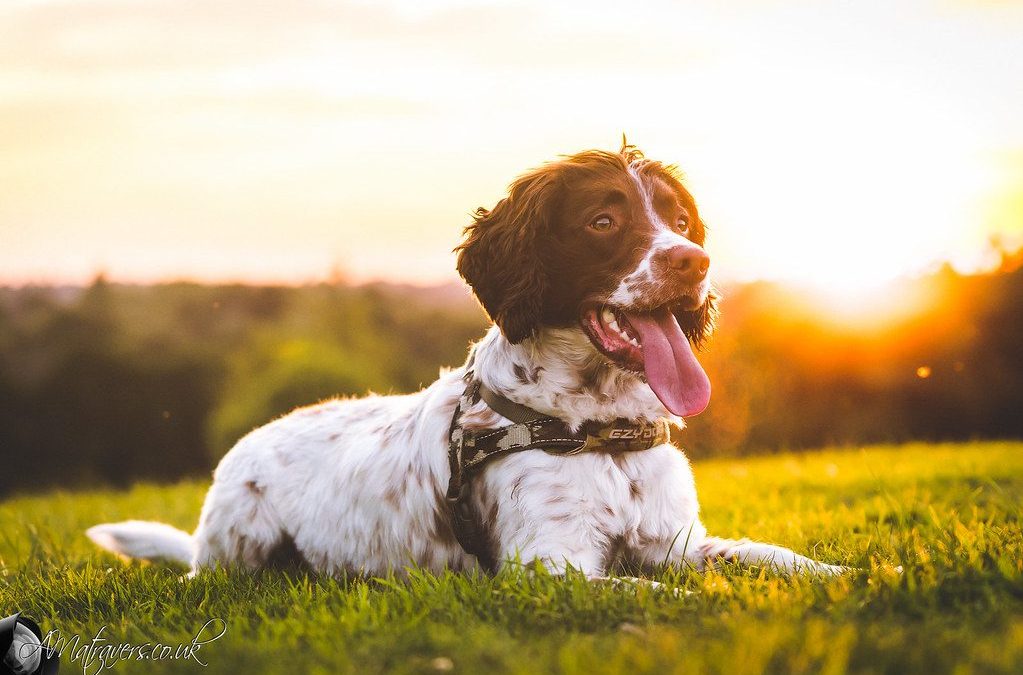
Overview
The English Springer Spaniel is a medium-sized flushing gundog — the breed that springs game from cover for the hunter, which is where the name comes from. Adults typically stand 19 to 20 inches and weigh 40 to 50 pounds, with a moderate double coat, feathering on the legs, chest and ears, and the long drop ears characteristic of the spaniel family.
Temperamentally, this is one of the most people-focused breeds in the sporting group. Springers are social, cheerful, eager to please and notably easy to train. They are not guard dogs and make poor ones; the default reaction to a stranger is enthusiasm.
There is one thing you need to understand before shopping, and most breed write-ups skip it. Over the last century, breeders have focused either on conformation or on field work, and the breed has effectively split into two distinct varieties — field and bench — that look and behave differently. Field-bred Springers are typically lighter-coated, higher-drive, and built for sustained work. Show-bred Springers carry more coat and are generally somewhat calmer. Both are properly bred English Springer Spaniels, but a field-bred dog in a sedentary household is a well-documented mismatch.
Here is the honest headline. For an active family that walks, hikes, runs or trains, and is home enough to keep the dog company, the Springer is superb. For a quiet household that wants a handsome dog to lie by the fire, it is a poor choice regardless of which variety you pick.
Breed Origin & History
Spaniels are an old type, documented in Britain for centuries, and were historically divided by function rather than by breed name — the larger dogs in a litter flushed game and the smaller ones worked differently. The English Springer Spaniel emerged from that working stock as a distinct breed in the nineteenth century, formalized as the specialist flushing spaniel.
The breed’s working purpose shaped everything about it. A flushing spaniel works close to the gun, quartering ground ahead of the hunter, pushing birds into the air and retrieving on command. That job requires stamina, a cooperative temperament, a soft mouth and a dog that wants to stay in contact with its handler. Those traits are precisely what modern owners experience as trainability and attachment.
The English Springer Spaniel Field Trial Association, founded in 1926, is the AKC parent club and stewards the breed standard in the United States. The club is candid that a century of divergent selection has produced two distinct varieties, and it advises prospective buyers to familiarize themselves with the spectrum before choosing — which is unusually direct advice from a parent club and worth taking seriously.
The breed has been consistently popular as both a working gundog and a family companion. That popularity has the usual consequence: demand attracts volume breeding, and health and temperament vary considerably by source.
Temperament & Personality
Springers are friendly, enthusiastic and strongly bonded to their people. They are among the easier breeds to train — genuinely eager to please, responsive to reward-based methods, and capable in obedience, agility, flyball, scent work and of course fieldwork. If you want a dog to actually do things with, this breed says yes to almost everything.
They are social to a fault. Springers love their people and do badly when isolated; the parent club notes plainly that they are unhappy when shut out, tied out or left alone. A Springer relegated to the yard becomes a frustrated, destructive, noisy dog. This is a house dog that works outside, not an outside dog.
Energy is high and needs a real outlet. An under-exercised Springer does not become calm — it becomes busy, mouthy and inventive. Field-bred dogs in particular carry drive that a couple of leashed walks will not touch.
Most are good with children and other dogs, with the caveat that an exuberant 45-pound adolescent can flatten a toddler without meaning any harm. The breed also retains a strong bird-and-scent drive, so recall training matters and a securely fenced yard is close to essential.
Individual variation is significant here precisely because of the field/bench split, so meeting the parents — and being honest with the breeder about your lifestyle — matters more than in most breeds.
Is This Breed Right for You?
The Springer suits active households that want a trainable, affectionate dog and will use it. Specifically: people who run, hike, cycle or spend real time outdoors. Families with school-age children who want a dog that plays. Anyone interested in dog sports — this breed is capable across almost all of them. Hunters, obviously, particularly those looking at field lines. Households where someone is home a good part of the day, or that can arrange daycare or a walker. Homes with a securely fenced yard.
It also suits first-time owners better than most sporting breeds, because the trainability and willingness make up for inexperience — provided the exercise commitment is genuinely met.
Here is who should think twice. Apartment dwellers and sedentary households; this is the clearest mismatch and the most common reason Springers are rehomed. Anyone out of the house for long days with no arrangement for the dog, given how badly the breed handles isolation. People who want a low-grooming dog, since the feathering needs regular attention and the drop ears need routine care. Anyone wanting a watchdog. Owners who cannot commit to recall training, because a scent-driven spaniel off-leash in an unfenced area is a dog you may spend an afternoon chasing.
And specifically: anyone drawn to a field-bred puppy because it is cheaper or more available, without the activity level to match. Ask the breeder directly which variety their dogs are and what those dogs need.
If you want a cheerful, capable, highly trainable companion for an active life, few breeds deliver more.
Care & Exercise Needs
Exercise is the central requirement. Plan on at least an hour to two hours of genuine activity daily for an adult — not a stroll around the block. Running, hiking, swimming, fetch and scent games all suit the breed, and mental work counts toward the total. Field-bred dogs need more.
One important caveat on young dogs: the parent club advises that concentrated running should be saved for the mature dog, because Springers are over two years old before their bones are hard enough for sustained impact work. Build activity gradually; do not take a ten-month-old jogging.
Grooming is moderate but regular. Brush at least weekly to keep the feathering free of mats and to manage shedding, with more attention during seasonal changes. Feathering on the legs, ears and chest collects burrs, mud and debris, so a working dog needs checking after every outing. Many pet owners keep the coat trimmed for practicality.
Ear care is not optional. Long drop ears with hair restrict airflow and trap moisture, and ear infections are one of the most common problems owners face. Check and clean routinely, and dry the ears thoroughly after swimming or wet walks.
Training should start early and lean on reward-based methods — Springers are soft and willing, and harsh handling produces an anxious dog rather than a compliant one. Recall deserves particular investment given the breed’s nose. Build tolerance for short periods alone deliberately from puppyhood.
Health Considerations
Several conditions are documented at elevated rates in the breed, and the parent club and breed foundation are unusually open about them.
Hip dysplasia is a standard concern in a dog of this size and build, and hip evaluation is part of routine breeder screening.
Eye conditions are significant. Progressive retinal atrophy occurs in the breed and is identifiable by DNA test in some forms. Retinal dysplasia is also reported, as is goniodysgenesis, a drainage-angle abnormality associated with glaucoma. Annual ophthalmologic evaluation of breeding stock is standard practice.
Phosphofructokinase deficiency is an inherited enzyme disorder found in the breed that causes episodes of muscle weakness and dark urine after exertion or stress. A DNA test exists and responsible breeders test for it — this is a specific, answerable question to put to any breeder.
Ear infections are extremely common and largely structural, a consequence of heavy drop ears rather than of any single disease.
The breed foundation has also identified epilepsy, cancer, bloat and autoimmune disorders as health concerns reported by owners and breeders. Those are broader patterns rather than single testable conditions, which makes a breeder’s transparency about their own lines especially relevant.
A healthy Springer commonly lives 12 to 14 years. Ask for documented hip, eye and PFK results on both parents rather than a general assurance. For any specific concern about your dog’s ears, eyes, joints or exercise tolerance, consult your veterinarian rather than relying on general breed information.
Recommended Gear Categories
Gear for a Springer is mostly about activity and ears. A well-fitted harness suits a dog that pulls toward interesting smells, and a long training line is genuinely useful while recall is being built — it lets the dog range without the afternoon-long chase that an unreliable recall eventually produces.
Ear care supplies belong in the routine kit: a veterinary ear-cleaning solution and absorbent pads, used consistently, prevent the most common problem this breed has. Dry the ears after every swim.
For grooming, a slicker brush and a metal comb handle the feathering, and thinning shears or a trip to a groomer keep the leg and ear furnishings practical for a dog that works in cover. A rubber curry helps with seasonal shedding on the body coat.
Because Springers love water and mud in roughly equal measure, a quick-dry towel, a dog-safe outdoor rinse and a waterproof seat cover for the car all earn their place quickly.
Enrichment matters as much as exercise. Puzzle feeders, snuffle mats, scent-work kits and durable fetch toys give a bright, high-drive dog something to do on days when a long outing is not possible. A properly sized crate introduced positively helps with settling and with the alone-time training this breed needs. Your editor will add specific product recommendations with current pricing and details.
Similar Breeds to Consider
The closest comparison is the English Cocker Spaniel — a smaller version of broadly the same idea, at 26 to 34 pounds. If the Springer’s temperament appeals but the size and exercise demand are too much, the English Cocker is the sensible step down, though it shares the ear care burden and much of the health picture.
The American Cocker Spaniel is smaller still and has been bred further toward the show ring, with a much heavier coat that demands considerably more grooming and a lower working drive. Choose it only if grooming time is not the constraint.
The Brittany is the strongest alternative for someone who wants a similar size and an even more athletic dog with less coat. Brittanys carry high energy and a pointing rather than flushing style, and their shorter coat is markedly easier to maintain. If your objection to the Springer is the feathering, this is the breed to look at.
The Labrador Retriever is worth comparing for families cross-shopping active medium-to-large dogs. Labs are heavier, shed more, and are generally more tolerant of chaotic households, with a comparable eagerness to please and similar exercise needs.
In short: choose the Springer for a trainable, affectionate gundog you will actively use; the English Cocker for the same in a smaller package; the Brittany if you want less coat and more athleticism; and a Lab if you want something sturdier for a busy family.